
Over the past few months, I’ve been preparing for my confirmation in the Church in Wales. Although I’ve always felt a spiritual connection with God, I resisted confirmation earlier in life. Much of that came from how the Bible was presented in Catholic school – often rigid, unquestionable, and disconnected from the complexity of real life.
Now, with the benefit of time, experience, and reflection, I find myself returning to faith with fresh eyes. What draws me to Anglicanism is its commitment to the “middle way” – a tradition that values scripture, tradition and reason, and invites discussion over dogma.
A full circle moment
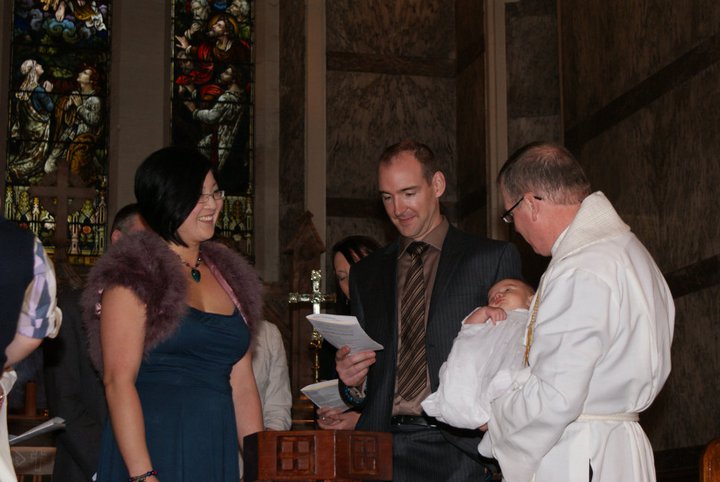
Fourteen years ago, my son was baptised in St John’s in Gowerton. I remember his tiny hand and his excited smile, both of us held in a sacred moment of hope and promise.
This month, we will stand together to be confirmed in the same tradition. It feels like a full circle – not a return to something I left behind, but a deeper step forward into faith, side by side. What once began with a baby’s baptism now becomes a shared affirmation of belief, choice and commitment.

A Question That Stirred Me
In a recent confirmation class, someone asked a powerful question:
“Does God love people who don’t believe in Him or in Jesus? Do they need to be converted to be saved?”
This stirred something deep in me. It reminded me of the ideologies that once caused me to turn away from institutional religion – especially the ways in which religion has historically been linked to racism, cultural erasure, and ideas of supremacy. This is the kind of thinking that made me decline confirmation the first time around.
But today, I return with a stronger sense of critical thinking and a deeper connection to scripture. I believe these are questions worth asking – and I hope you will consider them too.
God’s Love: Unconditional and Inclusive
From the first session of confirmation class, we were reminded of a bold Christian claim: God is love (1 John 4:8).
Not “God loves only the faithful.” Not “God loves Christians.” Just – God is love.
Scripture makes this clear:
- “While we were still sinners, Christ died for us.” (Romans 5:8)
- “He makes the sun rise on the evil and the good.” (Matthew 5:45)
God’s love is not a reward for belief. It is part of God’s very nature – boundless, generous and mysterious. So yes, I believe God loves all people, including those who do not believe in Him or who come to God in different ways.
Do People Need to Be Converted to Be Saved?
Here, Christian traditions offer different answers:
- Some believe salvation comes only through explicit belief in Jesus (John 14:6).
- Others – and I find myself among them – believe that God’s grace can work in ways we may not fully understand. A person may be responding to God in their life even without using the name “Jesus”.
Today, I will be reading Acts 11:1–18, but it is Peter’s earlier encounter with Cornelius that feels especially relevant. The early Church struggled with this very question: could someone outside the traditional faith be accepted by God? Peter’s conclusion is powerful:
“Who was I to think that I could oppose God?” (Acts 11:17)
Evangelism: Sharing or Supremacy?
Jesus said, “Go and make disciples of all nations” (Matthew 28:19). But the way that command has been carried out throughout history is troubling.
Too often, evangelism has been used as a cover for cultural domination. Consider:
- The Roman Empire replacing indigenous European spiritualities.
- Missionaries who erased Māori language and beliefs in New Zealand.
- The role of Christianity in colonisation, slavery, and assimilation.
Evangelism becomes harmful when it says:
“Our way is the only way. You must become like us to be loved by God.”
But that is not the Jesus I know.
Jesus crossed boundaries. He welcomed outsiders. He healed the marginalised and reached out to those his society rejected. He shared truth, yes – but he did not coerce.
To me, He showed us that faith is lived out in love, not in the conquest of belief systems.

Faith in Action, Not Supremacy
I believe in being a witness to Christ – but not by insisting others adopt my framework. Jesus said people would know his followers by their love (John 13:35), not by their arguments or conversions.
Christianity is not a badge of superiority. It is a path of humility, service and sacrificial love.
So instead of trying to “convert” others, perhaps our mission could be:
- To listen deeply to the spiritual journeys of others.
- To serve selflessly, as Christ did.
- To walk humbly, knowing that we do not own God.
The Spirit Moves Where It Will
In John 3:8, Jesus says:
“The wind blows wherever it pleases. You hear its sound, but you cannot tell where it comes from or where it is going.”
So it is with God’s Spirit. It cannot be boxed in by doctrine, denomination or geography. I believe that people of other cultures, other religions, and even those without religion can and do encounter God – sometimes in ways we might not recognise, but that God certainly does.
Aligning with the Church in Wales
Confirmation is not just a rite of passage – it is a commitment to live and serve by the values of the Church. For me, it is a statement of intent: to walk in faith with a community that reflects the love, openness and justice I believe are central to the message of Christ.
Before making this decision, I spent time researching different Christian traditions and denominations. I asked hard questions, revisited old doubts, and looked for a space where belief could live alongside reflection – where faith was expressed not through rigidity, but through compassion and action.
That is why I chose the Church in Wales.
The Church in Wales holds space for dialogue, encourages theological exploration, and values the balance between scripture, tradition and reason. It supports a vision of faith that is inclusive and evolving, not exclusionary or dogmatic.
The Church is also facing its history honestly – including its complicity in colonial systems – and is beginning the work of reconciliation and justice. It affirms that evangelism must be grounded in love, never in coercion or cultural erasure.
These values speak to me deeply. They allow me to affirm my faith not in spite of my questions, but because of them.
Final Thought
The gospel is good news – not for some, but for all.
Let us live it, not force it.
Let us witness through love, not conquest.
Let us trust that God is bigger than our categories – and always has been.
Acknowledgement
To Sue James Pellew, my sage and my sponsor, in faith and guidance.
 Enriched Science
Leave a comment